
Reserve Bank Governor Shaktikanta Das on Thursday said the central bank's asset purchases, aimed at mitigating COVID-19-related liquidity stress in the system, did not dilute its balance sheet or compromise on core principles of central banking. In the wake of the pandemic, the RBI undertook several conventional and unconventional measures. "Unlike many central banks, the RBI's asset purchases did not dilute its balance sheet and hence, did not compromise on core principles of central banking," Das said while addressing an event organised by the Bombay Chamber of Commerce. These purchases were confined to risk-free sovereign (government) bonds including state government securities only, he said.

Besides the pandemic that resulted in higher interest rates, the default by Future Retail has dealt a blow to investor sentiment.

The temptation to get into businesses that are hot is perhaps too great for any politician, no matter what his public slogans are. Nehru plunged into hot sectors of his time -- engineering and iron and steel. Modi has plunged into digital payments -- the hot sector of his time, notes Debashis Basu.
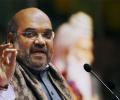
Shah said India's goal is to become a $ 5 trillion economy in the next five years and without contribution from the energy and petroleum sector, this goal can't be achieved.

Is the worst over for Indian banks? The past two years saw them ride on treasury trades as deposits soared and credit growth dipped sharply. Gross and net non-performing assets (NPAs) moved south, and the provision coverage ratio (PCR), capital buffers, and profitability indicators are back at pre-pandemic levels. So, what's the plot ahead?
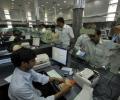
Nearly two million e-mandates for recurring payments have been registered with banks and card networks after the Reserve Bank of India (RBI) made it mandatory from October 1 to take prior consent of a customer before debiting her account, sources in know of the matter said. Industry estimates peg the recurring transactions at approximately 2.5 per cent of the total volume of transactions, and about 1.5 per cent in terms of value. Of these, around 75 per cent of domestic recurring transactions, and about 85 per cent international recurring payments are below Rs 5,000.
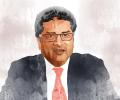
'The IPO market is cooling off and getting a reality check.'

This makes it the most valued fintech company in the country after Paytm and Walmart-owned PhonePe.

Experts say the new guideline is likely to hurt foreign players more, especially card companies such as Visa, MasterCard and American Express who process and store credit card transaction data outside of India.

The survivor, in her plea, also raised serious allegations against the trial court saying the presiding officer has some "vested interest to save the culprits".

The drop in net interest margin will separate the men from the boys, explains Tamal Bandyopadhyay.

The likelihood is that India will maintain a moderately upbeat economic tempo -- well short of tearaway growth, explains T N Ninan.

Grant Thornton's international business report claims India Inc to be most optimistic about economy.

'India's march towards being a $5 trillion economy continues, notwithstanding momentary setbacks.' 'India is at an inflexion point and most economists believe this growth super-cycle will extend for over four decades.'

From auto, refrigerator, and mobile handset makers to real estate firms, companies are tying up with banks to dole out attractive finance schemes and discounts to make buying more affordable.

The prime minister also welcomed convergence of views between India and ASEAN for cooperation in the Indo-Pacific region.

Recently, an Air India flyer sent a legal notice to the airline seeking damages of Rs 30 lakh for the breach of personal data of 4.5 million passengers, including her husband and herself. Air India had informed the complainant of the data leak a month earlier, after it emerged that its passenger service system provider fell prey to a cyberattack in February. However, in the absence of a data protection law, India lacks a mechanism for compensation or grievance redress of consumers in such cases, say experts. Advocate Virag Gupta, a New Delhi-based cyber law expert, explains that a legal notice is a good beginning in the Air India case, but it raises many questions. These include whether sensitive personal information has been leaked and whether the airline is responsible or not, given that a passenger service system provider was also involved.

Here's the full text of the maiden address to the nation by President Droupadi Murmu on the eve of Independence Day 2022.
Services and personal loans pulled down the non-food bank credit growth to 19.5 per cent at the end of February 27, 2009 as against 22 per cent a year ago.
Moody's has predicted a slow growth rate for India's industrial sector in 2008.

"I invite each one of you to become a partner in India's growth story. And once again assure you of our wholehearted support."

Tokenisation is the process of replacing debit and credit card numbers with a set of characters or tokens.

In the excitement over the allocation of bank licences for the private sector, a new category of licence offered by the Reserve Bank of India (RBI) last year went almost unnoticed. That was when the RBI consolidated the rules for prepaid payment instruments (PPI), popularly understood as e-wallets or gift cards. In the process, the regulator has fast-forwarded a bottom-up card usage industry in India that is completely different from the world of bank-linked credit and debit cards.

Billionaire Mukesh Ambani's Reliance Industries has started a limited test use of WhatsApp to connect customers to grocery stores, days after Facebook decided to invest USD 5.7 billion in digital assets controlled by the company. JioMart, an e-commerce venture of Reliance Retail, "has already started interacting with customers on WhatsApp for grocery orders" in Navi Mumbai, Thane and Kalyan, Credit Suisse said in a report.

The bank has already set up 68,000 'Yono cashpoints' and is in the process of scaling it up massively to over 1 million in the next 18 months, which will make the necessity to have a card even less.

'Dear Business Partner, Kindly note and inform your all customers that Digital Cashback has been revised from 0.75 per cent to 0.25 per cent with effect from August 1, 2018 across oil industry for all loyalty customers,' said the text message sent by State-owned oil companies to petrol pump operators.

GST rate cut for real-estate, income transfer scheme, farm loan waivers execution and recapitalisation of PSU banks have the potential to boost India's growth in a few months, says Neelkanth Mishra.

September import growth was the second lowest this fiscal year, after the April growth figures of 4.6 per cent, bringing the trade deficit down to $13.98 billion
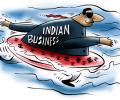
'Unless cash has ceased to be king, the issue is the same in the aviation, telecom and ecommerce sectors: Sustainability,' notes T N Ninan.

Record liquidity infusion by the central bank in the banking system during the financial year 2020-21 amid sluggish economic activity resulted in banks investing more in safe government papers than in extending loans, data from Reserve Bank of India (RBI) showed. This trend has not been seen in nearly two decades, barring 2016 - the year of demonetisation.

Despite strong AUM growth, MFs lag behind other popular investment avenues. MFs received only 6 per cent of total household savings in 2021-2022.

Unlike the race to buy airwaves by telecom companies, airports by infrastructure companies and city gas networks by energy companies, the race to develop super apps by consumer-facing companies in India has not brushed up against any regulatory issues. Officials at the ministry of electronics and information technology and at other regulators are happy they do not have to meddle in who among the Tata group, Reliance Industries Ltd, Flipkart or Paytm will manage to build an app that sweeps in customers. Unlike separate apps a customer uses on her mobile to order groceries, buy food or airline tickets or just make payments, a super app can perform all these functions.

Collectively, the pack of 12 has posted a 50 per cent rise in profits -- Rs 25,685 crore. On a quarter-on-quarter basis (that is, September over June), the rise is 68 per cent. Public sector banks have never had such a stellar performance, explains Tamal Bandyopadhyay.

So which sectors are likely to do well in 2022? Should you focus on domestic economy-related sectors or export-oriented ones?

'Citibank customers will migrate to the Axis Bank platform over 18 months.'

"In India's development cooperation, we will be guided by our partners' development priorities. Our assistance does not create indebtedness and is without conditionalities," he said at the 44th Annual Meeting of the G-77 Foreign Ministers on Thursday, in a veiled reference to China's loans which has led to debt-traps in some countries.

BharatPe co-founder Shashvat Nakrani has accused Ashneer Grover, with whom he had co-founded the payment startup, of creating a false narrative about the company, and said the board acted quickly and decisively in unseating him after receiving finds of a PwC report. BharatPe, which allows shop owners to make digital payments through QR codes, last week stripped Grover of all titles and positions over his alleged "misdeeds" and may take further legal actions, including clawing back of some of his shareholding. In a letter to employees, Nakrani said the Grover episode was an aberration and not the norm at BharatPe, and went on to defend the board who he said were celebrated names in the banking and financial services industry.

Believe it or not, the regulator is even stretching its arm to identify stressed borrowers and gauge the 'distance to default' as a measure of a particular bank's fragility, reveals Tamal Bandyopadhyay.

Addressing a G20 Summit session, Modi also presented his '5-I' vision to maximise digital technology for social benefit.

Even if it wants to censor what you read, watch, or consume, the amount of content online is so huge that it is physically impossible for any government to do it, notes Vanita Kohli-Khandekar.
